
Modular Kitchen vs Carpenter-Made Kitchen: Which Is Better for Punjab & Himachal Homes in 2026?

Quick Answer: A modular kitchen suits most Punjab, Himachal Pradesh, and Jammu homes better if you want faster installation, consistent finish, and stronger resistance to local humidity and termites. A carpenter-made kitchen can match this quality at a lower price, but only if you specify BWR plywood or HDHMR boards in writing and supervise the work closely. Budget, timeline, and material grade matter more than the modular-versus-carpenter label itself.
Key Facts:
Carpenter-made kitchen cabinetry with material typically costs ₹1,200 to ₹2,800 per square foot, while labour alone runs ₹120 to ₹300 per square foot.
A mid-range modular kitchen (60 to 80 sq ft, BWR plywood, branded hardware) typically costs ₹2.5 lakh to ₹4.5 lakh.
Branded modular showrooms charge roughly 30 to 60% more than local carpenters for the same material specification.
Both formats commonly last 10 to 15 years when built with BWR plywood or HDHMR instead of MDF or particle board.
The Real Dilemma Punjab & Himachal Homeowners Face
If you're planning a new kitchen in Pathankot, Dharamshala, or anywhere across Punjab and Himachal Pradesh, you've probably heard two very different opinions. Your parents likely trust the neighbourhood carpenter who built their kitchen decades ago. Your interior designer probably pushes a factory-made modular kitchen. Both have a point, and neither is automatically right for your home.
In our 10+ years designing and installing kitchens across Punjab, Himachal Pradesh, and Jammu, we've seen both formats succeed and both fail. The difference almost never comes down to "modular vs carpenter" alone. It comes down to what board is inside the cabinet, how well the edges are sealed against moisture, and whether the installer actually understands north Indian climate conditions.
This guide breaks down real costs, real material differences, and the specific climate and termite factors that matter in our region, so you can make a decision based on facts instead of opinions.

What's the Real Difference Between the Two?
A modular kitchen is built from pre-manufactured cabinet units, called modules, produced on CNC machines in a factory and assembled at your home. A carpenter-made kitchen is built entirely on-site, from raw plywood or blockboard, by a carpenter working from your layout.
Modular Kitchens: What You're Actually Buying
Machine-cut panels with precise, consistent joinery
Standardised module sizes (with filler panels for irregular spaces)
Factory quality control on board density and moisture content
Faster on-site installation, usually a few days once modules arrive
Warranty from the brand or vendor, typically 5 to 10 years
Carpenter-Made Kitchens: What You're Actually Buying
Fully custom-built cabinets, made to fit any layout or awkward corner
Materials sourced locally, quality depends on what the carpenter buys that day
On-site fabrication, which usually takes longer (often 1 to 3 weeks)
Easier last-minute changes during construction
Warranty, if offered at all, is informal and depends entirely on the individual carpenter
Neither format guarantees quality on its own. A modular kitchen built with cheap particle board will fail faster than a carpenter-made kitchen built with genuine BWR plywood. The board grade matters more than the label.
Cost Comparison: Modular vs Carpenter-Made Kitchen
Cost is usually the first question homeowners ask, and it's also the most misunderstood part of this decision. Here's a realistic breakdown for 2026.
Kitchen Type | Typical Cost Range | What It Usually Includes |
Basic carpenter kitchen (labour + local material) | ₹70,000 - ₹1.5 lakh | Basic plywood or blockboard, laminate finish, standard hardware |
Mid-range carpenter kitchen (BWR plywood specified) | ₹1.5 lakh - ₹2.8 lakh | BWR plywood carcass, better hardware, on-site customisation |
Basic modular kitchen | ₹80,000 - ₹1.5 lakh | Particle board or basic MDF carcass, laminate shutters |
Mid-range modular kitchen | ₹1.8 lakh - ₹4.5 lakh | BWR plywood or HDHMR carcass, soft-close hardware, granite countertop |
Premium modular kitchen | ₹4.5 lakh - ₹8 lakh+ | PU or acrylic finish, imported hardware, quartz countertop |
Labour-only carpenter rates typically run ₹120 to ₹300 per square foot if you supply the plywood, laminate, and hardware yourself. All-inclusive carpenter rates, where the carpenter supplies material too, usually land between ₹1,200 and ₹2,800 per square foot, depending on board grade.
Important: A carpenter kitchen isn't automatically the cheaper option once you match material quality. A carpenter-built kitchen using genuine BWR plywood and branded hardware can cost close to what a mid-range modular kitchen costs. The real savings in carpenter work come from skipping the brand markup, not from cutting material quality.
Material & Durability Comparison
This is where most homeowners in Punjab and Himachal Pradesh should focus their attention, because our climate is genuinely harder on kitchen cabinets than a dry, low-humidity region would be.
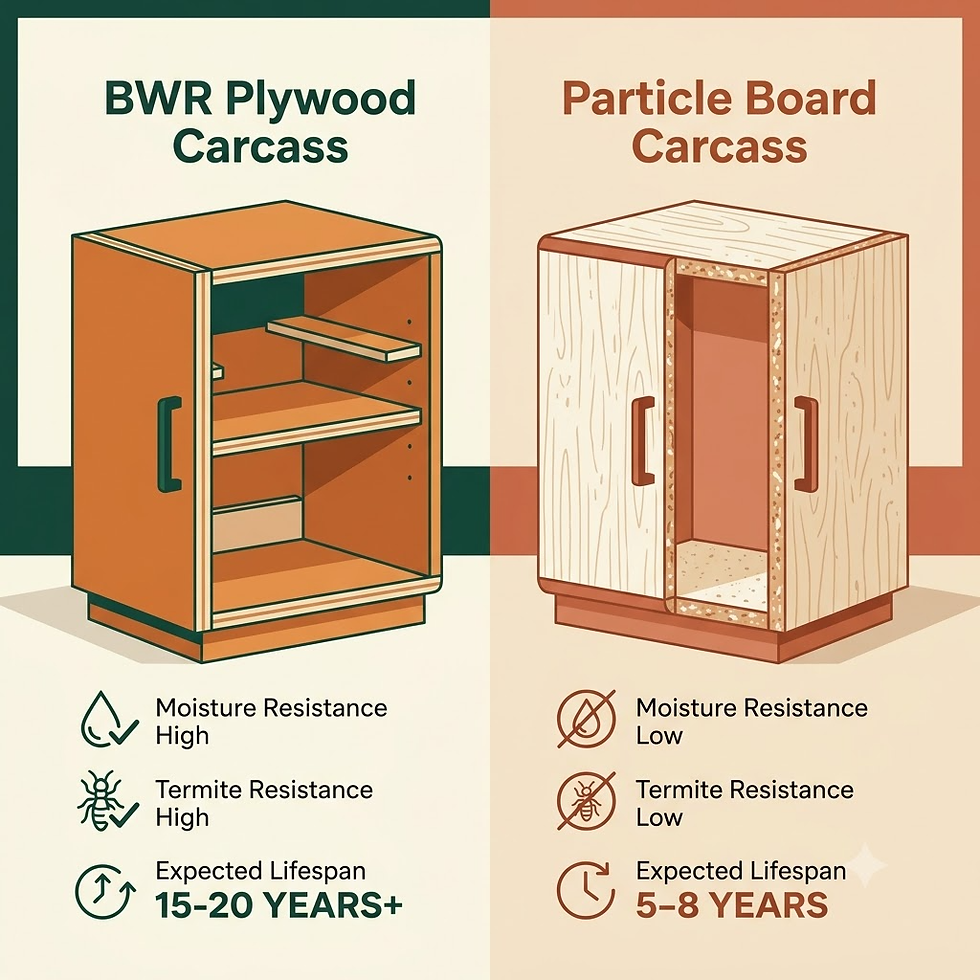
Material | Moisture Resistance | Termite Resistance | Typical Cost (per sq ft, board only) | Best For |
Particle board | Poor | Poor | ₹60 - ₹120 | Low-budget, low-moisture areas only |
MDF | Moderate | Poor | ₹80 - ₹150 | Dry-zone cabinets, decorative panels |
BWR (marine) plywood | Very good | Good, especially when treated | ₹90 - ₹160 (board) / ₹1,800 - ₹2,800 (finished) | Kitchen carcasses in humid or termite-prone areas |
HDHMR board | Very good | Very good | ₹150 - ₹250 | Under-sink units, high-moisture zones |
BWR plywood (boiling-water-resistant plywood) is built specifically to handle steam, spills, and daily moisture without swelling. HDHMR (a dense, engineered board) goes a step further on termite and moisture resistance, making it a strong choice for the cabinet directly under your sink, where water exposure is constant.
Both modular and carpenter-made kitchens can use either material. The difference is control: a factory buys boards in bulk from certified suppliers and tests them before use, while a carpenter buys from a local dealer and quality depends on what's available that day. If you're going the carpenter route, specify BWR plywood or HDHMR in writing and ask to see the board before it's cut.
The Punjab, Himachal Pradesh & Jammu Climate Factor
This is the section most competing articles skip entirely, and it's the one that should actually drive your decision in our region.
Termite Risk in Punjab & Jammu
Ground-level and semi-urban construction, common across residential Punjab and Jammu, carries real termite exposure through soil contact. Kitchens are especially vulnerable because constant moisture from cooking, steam, and spills creates the exact conditions termites need. This isn't a generic "Indian climate" issue. It's specific enough that plywood suppliers based right here in Pathankot market anti-termite treated plywood specifically to customers across Punjab, Haryana, Himachal Pradesh, and Jammu & Kashmir.
Temperature Swings in Himachal Hill Homes
Homes in Dharamshala, Kangra, and other hill areas of Himachal Pradesh deal with a second stress factor: sharp temperature swings between summer and winter. Wood and engineered boards expand and contract with these swings, and poorly sealed edges are where cabinets fail first, with panels warping or laminate peeling at the joints.
What This Means for Your Choice
Whichever format you choose, insist on:
BWR plywood or HDHMR for the carcass, not particle board or basic MDF
Proper edge banding on every cut edge, especially in hill-home installations
Anti-termite treatment on the plywood, verified with documentation if possible
Which One Should You Choose?
Use this simple decision framework:
Choose a modular kitchen if:
You want consistent factory quality control and don't want to supervise daily site work
Your timeline is tight and you need the kitchen ready in days, not weeks
You want a formal warranty from a company, not an informal promise from an individual
Your budget comfortably covers ₹1.8 lakh or more
Choose a carpenter-made kitchen if:
Your kitchen has an unusual layout or awkward corners that standard modules won't fit well
You have a trusted local carpenter with a verifiable track record
You're able to specify materials in writing and supervise the work
You want to control costs tightly without sacrificing board quality
Pro Tips from Our Expert Designers
Pro Tip: Always ask to see the plywood grade stamp before it goes into a cabinet. BWR-grade plywood is marked, and a good carpenter or vendor will show you without hesitation.
Pro Tip: For under-sink cabinets specifically, upgrade to HDHMR even if you use BWR plywood elsewhere. That single cabinet takes the most water exposure in the entire kitchen.
Pro Tip: In Himachal Pradesh hill homes, insist on double edge-banding on exposed panel edges. This is the single biggest factor in preventing warping from seasonal temperature swings.
Pro Tip: Get every quote broken into labour and material as separate line items, whether it's a carpenter or a modular vendor. This is the only way to compare quotes accurately.
Pro Tip: Ask for anti-termite treatment documentation on your plywood, not just a verbal assurance. This matters more in ground-floor Punjab and Jammu homes than in high-rise apartments.
Why Choose Modular Kitchen Experts for Your Kitchen in Punjab, HP & Jammu?
At Modular Kitchen Experts, we've spent over 10 years designing and installing kitchens across Pathankot, greater Punjab, Himachal Pradesh, and Jammu. We work in both formats: fully modular installations and carpenter-executed builds with factory-grade material, and we recommend whichever genuinely fits your home, budget, and timeline, not whichever earns us a bigger margin.
Every kitchen we build, modular or carpenter-executed, uses BWR plywood or HDHMR as standard, with proper edge banding and anti-termite treatment built into our process by default, because we've seen firsthand what Punjab and Himachal Pradesh's climate does to lower-grade boards. Our designers have handled everything from compact Pathankot apartment kitchens to full hill-home builds in Himachal Pradesh, and we bring that regional experience to every consultation.
Key Takeaways
The modular vs carpenter-made kitchen decision should be based on board material and installer reliability, not the label alone.
Carpenter-made kitchens aren't automatically cheaper once you match material quality to modular standards.
BWR plywood or HDHMR should be non-negotiable for any kitchen in Punjab, Himachal Pradesh, or Jammu, given real termite and humidity risk in the region.
Hill homes in Himachal Pradesh face an added risk from temperature swings, making edge sealing especially important.
Modular Kitchen Experts builds both formats to the same material standard across all three service regions.
Always get quotes broken into labour and material separately to compare fairly.
Planning a kitchen upgrade in Punjab, Himachal Pradesh, or Jammu? The expert team at Modular Kitchen Experts offers FREE consultations across all three regions. Book your free site visit today.
Frequently Asked Questions
Q: Is a modular kitchen cheaper than a carpenter-made kitchen?
A: Not necessarily. A basic modular kitchen can start lower, around ₹80,000, but once you match board quality (BWR plywood) and hardware brand between the two, the price gap narrows significantly. Carpenter work saves mainly on brand markup, not material cost.
Q: What's the biggest mistake homeowners make when choosing between the two? A: Choosing based on price alone without checking what board is inside the cabinet. Particle board and MDF look identical to BWR plywood from the outside but fail much faster in humid, termite-prone conditions common across Punjab and Jammu.
Q: Is BWR plywood really necessary for a kitchen in Himachal Pradesh?
A: Yes. Himachal Pradesh's hill homes face temperature swings that stress cabinet boards, and BWR plywood handles this expansion and contraction far better than particle board or basic MDF, especially with proper edge banding.
Q: How long does a modular or carpenter-made kitchen actually last?
A: With BWR plywood or HDHMR and proper installation, both formats typically last 10 to 15 years. The material grade matters more than whether it was factory-made or carpenter-built.
Q: Can a carpenter build a kitchen as good as a branded modular company?
A: Yes, if you specify the same material grade in writing, verify the plywood before it's used, and supervise the work. The quality gap comes from material and craftsmanship, not from the carpenter-vs-factory distinction itself.
Q: Do carpenter-made kitchens come with any warranty?
A: Rarely a formal one. Most carpenter warranties are informal verbal agreements, while modular vendors typically offer 5 to 10 years in writing. If warranty documentation matters to you, factor that into your decision alongside cost.


Comments