
L-Shaped Modular Kitchen Design India: Guide for Punjab, Himachal Pradesh & Jammu Homes

Quick Answer: An L-shaped modular kitchen uses two adjacent walls forming an "L" shape, creating an efficient work triangle between the sink, stove, and refrigerator. It suits spaces from 8×10 ft to 12×12 ft+ and costs between ₹1.5 lakh and ₹8 lakh+ in India, depending on size, material, and finish. It is India's most popular kitchen layout in 2026, holding over 57% of all installations.
Key Facts:
L-shaped kitchen layouts accounted for 57.23% of all modular kitchen installations in India in 2026 — the most popular layout nationwide
India's modular kitchen market is estimated at USD 5.67 billion in 2026 and is expected to reach USD 16.87 billion by 2030, growing at a CAGR of 24.36%
North India commands over 31% of the national modular kitchen market, making it the largest regional market in India
An L-shaped kitchen works in spaces as small as 8×8 feet, with budgets starting at approximately ₹2.5 lakh for laminate finishes and going above ₹8 lakh for premium acrylic or stone options
You've just moved into your new home in Pathankot, or you're renovating your family house in Dharamshala. The kitchen space has two free walls meeting at a corner — and you're wondering: "What's the best way to design this?"
This is the exact situation thousands of homeowners across Punjab, Himachal Pradesh, and Jammu face every year. And the answer, nine times out of ten, is an L-shaped modular kitchen.
For millions of Indian homeowners, the L-shaped kitchen design has become the answer — offering a perfect blend of functionality, style, and smart space utilisation that works beautifully in both compact flats and spacious homes.
But here's the problem: most guides you'll find online are written for Mumbai apartments or Bangalore tech flats. They don't account for the large joint-family kitchens of Punjab, the compact hill homes of Himachal Pradesh, or the monsoon humidity challenges of Jammu. This guide does.
In this article, you'll learn exactly what an L-shaped modular kitchen is, how to plan one for your specific home, what it costs in North India in 2026, which materials work best for our regional climate, and how to avoid the most common mistakes. We've designed hundreds of kitchens across Pathankot, Kangra, Dharamshala, and Jammu — and every insight here comes from real, on-ground experience.
Let's build your dream kitchen.

What Is an L-Shaped Modular Kitchen? (And Why Is It So Popular in India?)
The Core Definition
The L-shaped modular kitchen is designed with two adjacent walls forming a right angle, creating an "L" shape. This layout provides ample space for storage and a smooth workflow, making it ideal for both small and large kitchens. The term "modular" refers to the use of prefabricated units or modules that fit seamlessly together, ensuring a versatile and advanced kitchen.
In simple terms: your cabinets, countertop, and appliances run along two connected walls. The corner becomes a productive workspace rather than wasted space.
Why Indian Homeowners Love the L-Shape
Indian cooking requires multiple preparation areas, ample storage for spices and utensils, and efficient workflow between cooking zones. The L-shaped kitchen design addresses these needs brilliantly by creating two distinct walls that form a natural work triangle between the sink, stove, and refrigerator. This layout works exceptionally well in Indian homes because it:
Maximises corner space that would otherwise remain unused
Creates natural separation between wet and dry cooking areas
Offers flexibility for both traditional and contemporary cooking styles
Accommodates multiple family members cooking simultaneously
Provides excellent ventilation with two open sides
The Work Triangle Principle
The most efficient kitchen layouts are based on the principle of "The Working Triangle." This allows you to move easily between your sink, oven/cooktop, and refrigerator. L-shaped kitchens are an excellent example of this — workstations begin on two different walls, so you do not have to walk far to reach different zones, making meal prep more organised.
For North Indian cooking — think makki di roti with sarson da saag, or elaborate Punjab wedding-style cooking — this triangle is critical. You move from prep zone to hob to sink constantly. The L-shape makes this seamless.
Key Benefits of an L-Shaped Modular Kitchen for Indian Homes
1. Perfect for All Home Sizes
An L-shape modular kitchen is one of the most practical and space-efficient kitchen layouts for Indian homes. It uses two adjoining walls to form an "L" layout, creating an efficient work triangle while maximizing storage and movement space. It works in spaces as small as 8×8 feet and scales comfortably to 12×12 feet or larger.
This is especially relevant for Himachal Pradesh homes where hill terrain means smaller kitchen footprints and for large Punjab bungalows where you need to fill a generous space productively.
2. Maximises Corner Space
Corner areas are usually wasted in traditional kitchens. The L-shaped design transforms the corner into functional storage using:
Carousel (Lazy Susan) units — rotating shelves that give full access
Magic corner pull-outs — extend outward so you can reach the back easily
Blind corner solutions — for maximum storage without dead zones
Key upgrades that add maximum value: handleless cabinets, under-cabinet LED lighting, carousel corner units, and breakfast counter extensions.
3. Open-Plan Friendly
The L-shaped modular kitchen design is one of the most suitable designs for open kitchen concepts with its ability to seamlessly integrate into a larger interior design. These designs usually open into adjacent living or dining areas, creating a sense of openness and comfort in modern homes.
Modern homes in Jammu's newer residential areas (like Trikuta Nagar and Gandhi Nagar) and Pathankot's growing residential colonies are increasingly being built with open-plan layouts — the L-shape fits perfectly.
4. Ideal for Multi-Cook Indian Families
The L-shape layout accommodates multiple family members cooking simultaneously and provides excellent ventilation with two open sides.
In joint families across Punjab where multiple people cook together daily this is not a luxury. It's a necessity.
How to Plan Your L-Shaped Modular Kitchen: Step-by-Step
Step 1 — Measure Your Space Correctly
A comfortable L-shaped kitchen generally requires at least 8 ft × 10 ft of space.
Measure both walls carefully. In hill homes in Dharamshala or Kangra, irregular wall shapes are common. Our designers at Modular Kitchen Experts always do a physical site visit before finalising any layout measurements taken remotely are often inaccurate by 2–4 inches, which can cause expensive fitting issues later.
Recommended minimum dimensions:
Short arm of the "L": minimum 8–10 feet
Long arm of the "L": minimum 10–12 feet
Aisle width (walking space): minimum 3.5–4 feet (42–48 inches)
Step 2 — Place Your Three Key Points
Start by identifying the location of the sink, stove, and refrigerator — these are the essential components of any kitchen.
For North Indian homes, we recommend:
Sink → on the wall near the window (natural light + ventilation)
Hob/Stove → in the middle of the longer arm (work counter on both sides)
Refrigerator → at one end of the L (not blocking the work triangle)
Always position the stove in the southeast corner for Vastu compliance
Step 3 — Plan Your Storage Zones
Vertical storage using tall pantry units and wall-mounted shelves is the single most effective space-saving strategy.
Divide your kitchen into three functional zones:
Wet zone → sink area (washing, drainage, water-heavy tasks)
Dry zone → prep counter (chopping, spice mixing, rolling chapati)
Hot zone → hob, chimney, and adjacent countertop
Step 4 — Choose Your Corner Solution
The corner is where most kitchens fail. Don't leave it as dead space. Options include:
Carousel/Lazy Susan — best for round-shaped corner space
Le Mans unit — kidney-shaped shelves that pull out fully
Magic corner — two-tier pull-out with maximum accessibility
Diagonal sink placement — places the sink in the corner for a unique look
L-Shaped Modular Kitchen Cost in India 2026: Complete ₹ Breakdown
This is the section most guides get wrong. Here is a real, verified cost breakdown for 2026, specifically relevant to North India and Tier-2 cities like Pathankot, Dharamshala, and Jammu.
Cost by Kitchen Size
Kitchen Size | Estimated Cost (Budget) | Estimated Cost (Mid-Range) | Estimated Cost (Premium) |
Small (up to 80 sq ft) | ₹1.5L – ₹2L | ₹2.5L – ₹3.5L | ₹4L – ₹5.5L |
Medium (80–120 sq ft) | ₹2L – ₹3L | ₹3.5L – ₹5L | ₹5.5L – ₹7L |
Large (120 sq ft+) | ₹3L – ₹4L | ₹4.5L – ₹6L | ₹7L – ₹10L+ |
Estimates based on verified 2026 market data for North India Tier-2 cities. Actual cost depends on site conditions, brand of hardware, and accessories.
Cost by Material & Finish
Core Material | Price per Sq Ft | Best For |
MDF / Particle Board | ₹1,200 – ₹1,800 | Budget, dry climates |
Marine Ply (BWR/BWP) | ₹1,800 – ₹2,800 | North India — moisture resistant |
Solid Wood / High-End Ply | ₹2,500 – ₹3,200 | Premium, long-lasting |
Cost by Finish Type
Finish | Relative Cost | Durability | Best For |
Laminate | Low (base price) | Good | Budget, everyday use |
Membrane/PVC | Medium (+15–20%) | Very Good | Mid-range, easy maintenance |
Acrylic | High (+30–40%) | Excellent (scratch-resistant) | High-gloss, premium look |
PU Paint | Highest (+40–50%) | Premium | Luxury, seamless finish |
What's Typically Included in the Quote?
A standard modular kitchen quote should include:
All base cabinets and wall cabinets
Countertop (granite or quartz as per tier)
Chimney and hob (mid-range and above)
Sink and faucet
Hardware (hinges, channels, handles)
Installation charges
Not usually included: Electrical work, plumbing changes, tiles, painting, and premium accessories (pull-outs, carousels). Always ask for a full itemised quote.
North India pricing note: Tier-2 cities in North India typically see rates of ₹1,200–₹2,500 per sq ft, which is 15–25% lower than metro cities — making places like Pathankot, Jammu, and Dharamshala great value for quality modular kitchens.
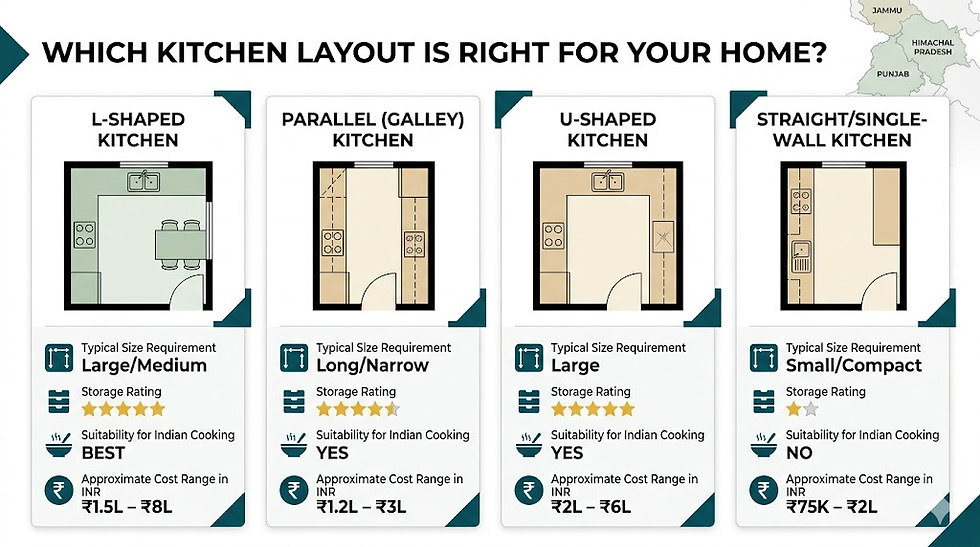
L-Shaped vs Other Kitchen Layouts: Full Comparison
The L-shaped kitchen design represents one of the most versatile and practical layouts available today. Unlike traditional single-wall kitchens that often feel cramped, or U-shaped designs that require substantial space, the L-shaped modular kitchen design offers the perfect middle ground.
Feature | L-Shaped | Parallel / Galley | U-Shaped | Straight / Single Wall |
Min. Space Required | 8×10 ft | 8×8 ft | 10×10 ft | 6×8 ft |
Storage Capacity | ★★★★☆ | ★★★☆☆ | ★★★★★ | ★★☆☆☆ |
Work Triangle Efficiency | ★★★★★ | ★★★★☆ | ★★★★☆ | ★★★☆☆ |
Open Plan Compatibility | ★★★★★ | ★★★☆☆ | ★★☆☆☆ | ★★★★☆ |
Multi-Cook Friendly | ★★★★☆ | ★★★☆☆ | ★★★★★ | ★★☆☆☆ |
Budget Range (India) | ₹1.5L–₹8L+ | ₹1.2L–₹3L | ₹2L–₹6L | ₹75K–₹2L |
Best For | Most Indian homes | Compact flats | Large families | Studio/1BHK |
Corner Space Use | Excellent | N/A | Excellent | N/A |
Vastu Friendly | Yes (SE stove) | Yes | Yes | Yes |
Our recommendation for North India:
Punjab large homes → L-shaped or U-shaped
HP hill homes (compact) → L-shaped (best fit for corner space)
Jammu apartments → L-shaped (humidity-resistant materials critical)
Budget builds → L-shaped with laminate finish + marine ply carcass
L-Shaped Modular Kitchen Design for Punjab, Himachal Pradesh & Jammu: Regional Guide
This is the section no one else has written. Here is what you actually need to know about L-shaped modular kitchens in our specific region.
Designing for Punjab Homes
Popular for sprawling bungalows and farmhouses, the people of Punjab enjoy large kitchens with open spaces. Wet and dry kitchens work wonderfully here, along with bright colours and grand finishes.
Punjab-specific design recommendations:
Size: Generous — aim for 10×12 ft or larger where possible
Finish: High Gloss Lacquer or Wooden Laminates (most popular in Ludhiana/Pathankot region)
Colour: Bold two-tone combinations — navy + white, olive + cream
Countertop: Quartz or black granite (durable for heavy Punjabi cooking)
Chimney: Mandatory — heavy-use hobs with high CFM chimney essential
Storage: Extra-deep base drawers for large kadais, pressure cookers, tawas
Island/Breakfast bar: Common in larger Punjab kitchens — adds functionality
Cultural consideration: Punjab kitchens often serve as a social hub during family gatherings and festivals. Plan for an open layout that feels welcoming and spacious.
Designing for Himachal Pradesh Hill Homes
Hill homes in Dharamshala, Kangra, Mandi, and Shimla have unique challenges:
Unique architectural quirks include low ceilings, alcoves, winter insulation requirements, and verandas — every inch of your kitchen needs careful thought.
HP-specific design recommendations:
Size: Typically compact — 8×10 ft is common; L-shape maximises this perfectly
Materials: Marine plywood for cabinets and quartz or granite for countertops — essential in hill climate for moisture resistance and durability
Cold climate protection: Ensure soft-close hardware is rated for temperature variations (cheap hinges seize in cold winters)
Ceiling height: Use tall cabinets up to ceiling level — vertical storage is critical in HP's compact kitchens
Natural light: Position sink under window for maximum natural light in often north-facing hill kitchens
Vastu: In HP traditional homes, the kitchen is often on the east side — the L-shape works ideally here
For Himachali cottages, consider deodar wood accents with iron fittings for a local, heritage-inspired aesthetic that blends with the L-shaped modular structure
Designing for Jammu Homes
In Jammu, a city steeped in tradition yet steadily embracing modernity, the concept of modular kitchens is transforming how residents design and use this vital space.
Jammu-specific design recommendations:
Climate challenge: Humidity during monsoons can challenge traditional wooden kitchens in Jammu moisture-resistant materials are non-negotiable
Material choice: BWR (Boiling Water Resistant) or BWP (Boiling Water Proof) plywood only no particle board in Jammu's climate
Finishes: Membrane or acrylic preferred over plain laminate in humidity-prone areas
Ventilation: A well-ventilated kitchen with a high-quality chimney is essential for Jammu homes, given the popularity of oil-heavy traditional cooking
Local cuisine storage: Plan dedicated pull-outs for rajma, rice, dals, and large cooking vessels
Home types: Homes range from sprawling bungalows in Gandhi Nagar to compact apartments in Trikuta Nagar the L-shape suits both
Mid-Article CTA:
Planning an L-shaped modular kitchen in Punjab, Himachal Pradesh, or Jammu? The expert team at Modular Kitchen Experts offers FREE home consultations across the entire region — from Pathankot to Dharamshala to Jammu city. We visit your site, measure accurately, and create a 3D design tailored to your home and budget. Book your FREE consultation today →
Why Choose Modular Kitchen Experts for Your L-Shaped Kitchen in Punjab, HP & Jammu?
In over 10+ years of designing and installing kitchens across Pathankot, Punjab, Himachal Pradesh, and Jammu, the team at Modular Kitchen Experts has learned what no online guide can teach you:
Every home in North India is different.
A kitchen in a Kangra hill home needs completely different materials than a kitchen in a Jammu city apartment. A large Punjab bungalow kitchen requires different space planning than a compact 2BHK in Trikuta Nagar, Jammu. Cookie-cutter designs fail here.
Here's what sets Modular Kitchen Experts apart:
Free on-site consultation and accurate measurement — no surprise errors during installation
North India climate-tested materials — we only use BWR/BWP plywood and tested hardware that handles Punjab summers, HP winters, and Jammu monsoons
3D kitchen design before you commit — see your kitchen before a single cabinet is made End-to-end service — design, supply, installation, and after-service all under one roof in Pathankot
Local expertise — we understand Vastu requirements, joint family cooking habits, and regional storage needs
Competitive North India pricing — no metro-city overheads passed on to you
We've helped homeowners from Pathankot, Gurdaspur, Nurpur, Dharamshala, Kangra, Palampur, Mandi, Jammu, Udhampur, and Kathua create kitchens they love every single day.
"A kitchen designed for how you actually cook — that's our promise at Modular Kitchen Experts."
Materials Guide: What Works Best in North India's Climate
Getting your materials right is the single most important decision in kitchen planning. Here's the complete guide:
Cabinet Core Materials
Material | Moisture Resistance | Durability | Best For North India |
Particle Board / MDF | Low | 5–8 years | Not recommended (Punjab humidity/HP cold) |
BWR Plywood (Marine Ply) | High | 15–20 years | Best choice for all three regions |
BWP (Grade 710) Plywood | Very High | 20+ years | Best for Jammu (monsoon humidity) |
HDHMR Board | Medium-High | 12–15 years | Good budget option for drier areas |
Countertop Options
Countertop | Heat Resistance | Durability | Cost Range | Recommended? |
Black Granite | Excellent | 20+ years | ₹150–₹250/sq ft | Budget-best |
Quartz | Excellent | 20+ years | ₹350–₹700/sq ft | Best overall |
Marble | Medium | 10–15 years | ₹300–₹800/sq ft | High maintenance |
Corian/Solid Surface | Good | 15+ years | ₹500–₹1,200/sq ft | Seamless look |
Quartz and granite are considered the best choices** because Indian cooking often involves high heat and frequent cleaning — both materials handle this with ease.
Finish Options for North India
Laminate: Most affordable, huge colour range, easy to maintain. Laminate is affordable and widely used across India. Best for budget-conscious builds.
Acrylic: High-gloss, modern, scratch-resistant. Acrylic is high-gloss and scratch-resistant, costing a bit more. Best for statement kitchens in Punjab.
Membrane/PVC Foil: Smooth, no visible joint lines, great for Himachal Pradesh hill homes where moisture affects laminate edges.
PU Paint: Seamless, paintable finish. Premium. Recommended for Jammu homes that want a luxury look.
Smart Storage Solutions for L-Shaped Modular Kitchens
Indian cooking demands more storage than any standard kitchen guide accounts for. Here's the complete storage system for your L-shaped kitchen:
Base Cabinet Solutions
Deep drawers (500mm deep) — for pressure cookers, kadais, and large pots
Pull-out pantry — narrow 150mm pull-outs for oils, sauces, and spice bottles
Dustbin unit — built-in segregated waste bins (essential)
Under-sink organiser — cleaning supplies, drain pipes planned around
Wall Cabinet Solutions
Lift-up shutters — for upper cabinets over the countertop
Glass-door cabinets — display crockery and create depth
Spice pull-outs — narrow vertical pull-outs for masala containers (a must for Indian kitchens)
Corner Solutions
Maximise storage capacity with innovative solutions such as pull-out drawers, carousel units, and corner cabinets — every storage requirement should be met with precision, from deep drawers for pots and pans to vertical pull-outs for spices.
Tall Units
Vertical storage using tall pantry units** is the single most effective space-saving strategy for Indian kitchens. A 7-foot tall pantry unit on one arm of the L can hold everything from your atta dabba to your mixer-grinder, freeing up the countertop completely.
Vastu Tips for L-Shaped Modular Kitchens in North Indian Homes
Vastu Shastra plays an important role in kitchen planning for many families across Punjab, Himachal Pradesh, and Jammu. Here are the key principles:
Best kitchen location in home: Southeast corner of the house
Cook facing: East while cooking — associated with positive energy and health
Stove placement: Always position the stove in the southeast corner for Vastu compliance
Sink placement: North or northeast corner preferred
Refrigerator: Southwest or south wall — never directly adjacent to the stove
Colour for Vastu: Yellow, orange, and red tones are Vastu-approved for kitchens; Indians love red kitchens because they are Vastu-compliant
Windows: East-facing windows are ideal for morning light and positive energy
The good news: the L-shaped layout is inherently Vastu-friendly because it naturally separates the fire element (stove, southeast) from the water element (sink, northeast) across the two arms of the "L."
Pro Tips from Our Expert Designers
At Modular Kitchen Experts, after years of designing kitchens specifically for North Indian homes, here are our top expert tips that most guides miss:
Pro Tip 1: Never use particle board in Jammu or hill areas of HP. Jammu's monsoon humidity and HP's winter condensation will cause particle board to swell and warp within 3–5 years. Always specify BWR-grade marine plywood — the extra ₹15,000–₹25,000 upfront saves you a full kitchen replacement in under a decade.
Pro Tip 2: The corner carousel is worth every rupee. In our experience, homeowners who skip the carousel to save ₹8,000–₹12,000 deeply regret it. Within 6 months, the corner becomes a graveyard of forgotten utensils. A carousel or magic corner unit pays for itself in daily convenience.
Pro Tip 3: Plan your chimney duct BEFORE the kitchen layout is finalised. In Punjab homes with concrete slabs, routing a chimney duct after the kitchen is installed can cost ₹10,000–₹25,000 extra and requires breaking finished walls. Plan the duct route first — always.
Pro Tip 4: For HP hill homes, insulate your base cabinets. In Dharamshala and Kangra, temperatures drop below 5°C in winter. Standard cabinet materials contract and expand with temperature swings. Ask for hardware with cold-climate rated hinges and channels (Hettich or Häfele brands are reliable for this).
Pro Tip 5: Get a 3D design rendered before approving the final layout. A 2D drawing cannot tell you that your chimney is too close to the window, or that your refrigerator door swings into the prep counter. A 3D render reveals these issues before installation — saving you thousands in corrections.
Key Takeaways:
L-shaped modular kitchens are India's most popular layout in 2026, holding a 57.23% share of all modular kitchen installations — and for good reason.
The L-shape uses two adjoining walls to form an efficient work triangle, maximizing both storage and movement space — perfect for Indian cooking needs.
In North India, always use BWR or BWP plywood as the cabinet core material — particle board and cheap MDF will fail within 5 years due to humidity and temperature variations in Punjab, HP, and Jammu.
The layout suits spaces from 8×8 ft to 12×12 ft+, with budgets ranging from ₹2.5 lakh to ₹8 lakh+ depending on size, finish, and accessories.
Regional design matters: A Punjab bungalow kitchen, an HP hill home kitchen, and a Jammu apartment kitchen each have unique requirements — work with a local expert who knows your region.
Modular Kitchen Experts (Pathankot) provides end-to-end L-shaped kitchen design, supply, and installation across Punjab, Himachal Pradesh, and Jammu — with a free on-site consultation.
Frequently Asked Questions
Q: What is the minimum size required for an L-shaped modular kitchen in India? A: A comfortable L-shaped kitchen generally requires at least 8 ft × 10 ft of space. The short arm should be a minimum of 8 feet and the longer arm at least 10 feet. This gives you enough countertop run, cabinet storage, and a comfortable aisle width of 3.5–4 feet. Smaller homes in Himachal Pradesh can work with 8×8 ft using compact modular units.
Q: What is the cost of an L-shaped modular kitchen in India in 2026?
A: The average cost of an L-shaped modular kitchen in India is between ₹2 lakh and ₹2.5 lakh for standard configurations. Premium variants can cost up to ₹8 lakh or more, while entry-level models start at around ₹1.5 lakh. In North India Tier-2 cities like Pathankot, Dharamshala, and Jammu, costs are typically 15–20% lower than metro prices. Material choice, finish, and accessories are the biggest cost variables.
Q: Is an L-shaped kitchen better than a parallel (galley) kitchen for Indian homes?
A: Both have merits. Unlike single-wall or U-shaped designs, the L-shaped modular kitchen offers the perfect middle ground — it creates distinct work zones while maintaining an open, airy feel. A parallel kitchen suits very narrow spaces (less than 8 ft wide), while the L-shape is better for open-plan homes, corner spaces, and multi-cook families. For most Indian homes in Punjab, HP, and Jammu, the L-shape is the superior choice.
Q: Which material is best for an L-shaped modular kitchen in North India (Punjab, HP, Jammu)? A: For all three regions, we strongly recommend BWR-grade marine plywood as the cabinet carcass (core) material. Marine plywood for cabinets and quartz or granite for countertops work best in the North Indian hill and Jammu climate due to moisture resistance and durability. Particle board and basic MDF fail within 3–5 years in areas with humidity or temperature variation. For the finish, laminate is best for budget builds; acrylic or membrane for mid-range and premium.
Q: How do I use the corner space effectively in an L-shaped modular kitchen?
A: The corner is the most critical space in an L-shaped kitchen. Maximise it with innovative solutions such as pull-out drawers, carousel units, and corner cabinets — from deep drawers for pots and pans to vertical pull-outs for spices. The best options are: (1) Lazy Susan / Carousel unit — rotating shelves for round corners; (2) Magic Corner pull-out — two-tier extending shelves; (3) Diagonal sink placement — uses the corner as the sink area, eliminating dead space entirely.
Q: Can I add a breakfast counter or island to my L-shaped modular kitchen? A: Yes — but only if you have sufficient space. A kitchen island makes sense in an L-shaped kitchen only when there is a minimum clearance of 900mm (about 3 feet) on all sides of the island. For most standard Indian apartments (under 100 sq ft kitchen), a compact breakfast bar attached to one arm of the "L" is more practical than a full island. It adds seating, countertop space, and a casual dining zone without eating into your walking area. At Modular Kitchen Experts, we can design both options based on your actual floor plan.
The L-shaped modular kitchen is not just a trend — it is India's most proven kitchen layout, and it works beautifully in the homes of Punjab, Himachal Pradesh, and Jammu.
Whether you are designing a grand kitchen for your Pathankot family home, a compact but efficient kitchen for your Dharamshala hill cottage, or a humidity-resistant, practical kitchen for your Jammu apartment — the L-shape offers the best balance of space, storage, workflow, and style for Indian cooking.
With India's modular kitchen market growing at an impressive CAGR of over 24% and North India leading regional demand, there has never been a better time to invest in a quality modular kitchen that will serve your family for the next 15–20 years.
The key is to plan right, choose climate-appropriate materials, and work with a team that truly understands your region. At Modular Kitchen Experts, based in Pathankot, we have spent years understanding the specific needs of North Indian homes — from the bold, spacious kitchens of Punjab to the compact, cold-weather-ready kitchens of Himachal Pradesh and the humidity-challenged homes of Jammu.
Your dream L-shaped kitchen is closer than you think — and it starts with a conversation.
Book Your FREE L-Shaped Kitchen Consultation Today
Modular Kitchen Experts — Pathankot, Punjab Serving: Punjab | Himachal Pradesh | Jammu


Comments